
When to Split Pairs in Blackjack
Always split aces and eights on this six-deck table. Never split fives or tens. Use the dealer upcard to decide the other pairs, and check the rules before adding a second wager.
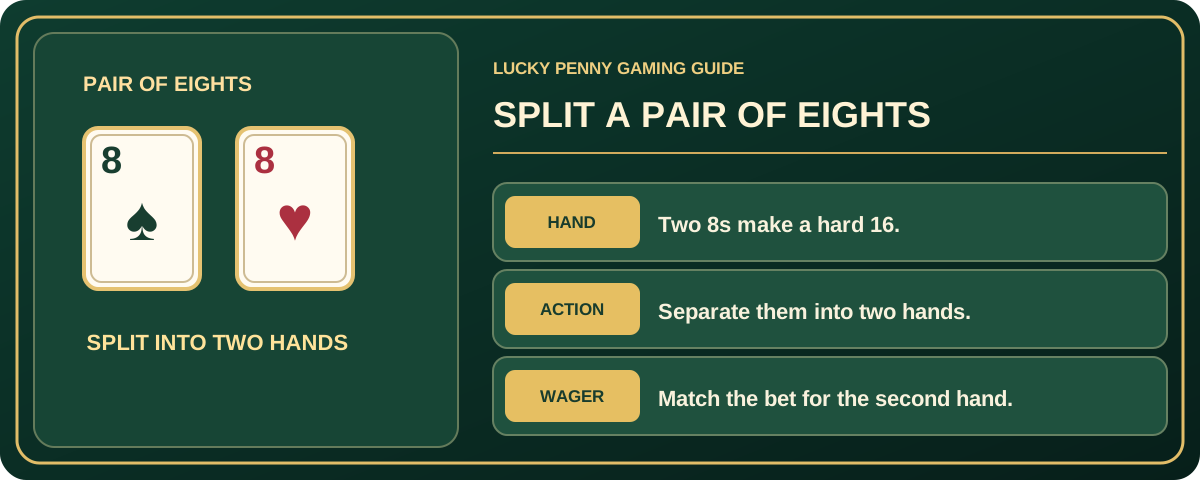
How does splitting a pair work?
When your first two cards have the same rank, place a second wager equal to the first. Each card becomes the start of its own hand and receives another card. A pair of eights with a $10 starting bet therefore creates two $10 hands, with $20 total at risk.
The Lucky Penny table allows doubling after a split and up to four hands total. Split aces receive one card each. If a matching card appears again, resplitting depends on the available table action and the four-hand limit; an ace pair is subject to the split-ace restriction. A 21 made after splitting is not a natural blackjack payout.
When should you split in blackjack?
This chart uses the same rules as the Lucky Penny table: six decks, dealer stands on soft 17, and doubling after a split is allowed. The dealer card always matters unless the recommendation says “split” or “stand.”
| Your pair | Basic strategy | Why |
|---|---|---|
| A,A | Split | Two chances to begin with an ace are worth more than playing soft 12. |
| 10,10 | Stand | Twenty is already an excellent hand. Do not break it apart. |
| 9,9 | Split vs. 2–6 and 8–9 | Stand against 7, 10, or ace. |
| 8,8 | Split | Sixteen is weak; splitting creates two chances to improve. |
| 7,7 | Split vs. 2–7 | Hit against 8 through ace. |
| 6,6 | Split vs. 2–6 | Assumes doubling after a split is allowed; otherwise split vs. 3–6. |
| 5,5 | Never split | Play the hand as hard 10: double vs. 2–9, otherwise hit. |
| 4,4 | Split vs. 5–6 | Only with doubling after a split; otherwise hit. |
| 3,3 | Split vs. 2–7 | Assumes doubling after a split; otherwise split vs. 4–7. |
| 2,2 | Split vs. 2–7 | Assumes doubling after a split; otherwise split vs. 4–7. |
Why aces and eights are always split
Split aces to create two strong starts
Two aces total soft 12, which is not a strong finished hand. Splitting gives each ace a new card and two independent chances to make 21. Most casinos deal only one additional card to each split ace, but splitting remains the correct play.
Split eights to escape hard 16
Hard 16 is one of blackjack’s worst starting totals. Splitting does not guarantee a profit, especially against a dealer 10 or ace, but two hands beginning with 8 lose less over time than playing the original 16.
Pairs that tempt players into the wrong move
Do not split tens. Two hands starting with 10 may look exciting, but breaking up a made 20 sacrifices one of the strongest hands in the game.
Do not split fives. A pair of fives is a hard 10, a powerful doubling hand against dealer cards 2 through 9. Splitting replaces that advantage with two mediocre starting hands.
Do not split simply because the cards match. Pairs are still governed by the dealer’s upcard. Sevens are split against a dealer 6, for example, but hit against a dealer 10.
Do not chase losses by resplitting automatically. If another matching card appears, apply the same strategy again, but first confirm the table permits resplitting and that you can comfortably fund another wager.
How blackjack rules change splitting strategy
Doubling after a split, usually shown as DAS, makes small pairs more valuable because a favorable next card can be doubled. Without DAS, split 2s, 3s, 4s, and 6s less often. Also check whether the casino permits resplitting aces, how many total hands may be created, and whether a blackjack after splitting aces pays only even money instead of the usual 3:2.
Splitting requires a second wager equal to the original bet. Choose a starting bet small enough that the correct split or double remains affordable when the opportunity appears.
Practice the decision, not just the chart
Use the free Blackjack table and Strategy Coach to see pair decisions in context with real dealer upcards.
Play Blackjack Free