
Blackjack Basic Strategy: When to Hit, Stand, Double, and Split
Basic strategy uses the player's hand and dealer's up-card to identify the mathematically preferred action. Use this chart to learn when to hit, stand, double, or split under the rules used on the Lucky Penny table.
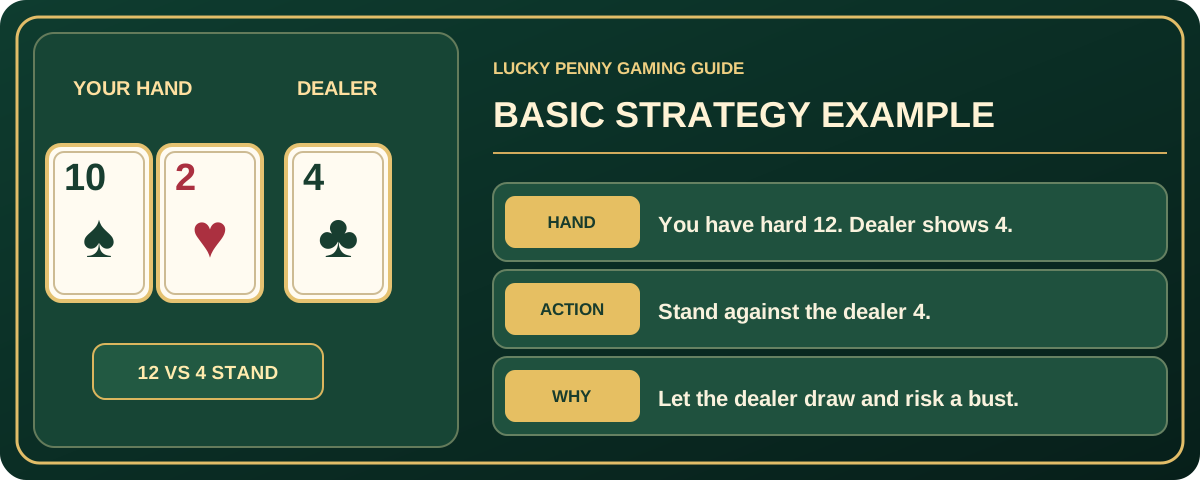
Basic strategy is the mathematically preferred decision for your hand against the dealer's visible card. It does not predict the next card or guarantee a winning hand, but it reduces avoidable decision errors over time.
First, identify the hand you actually have
Hard hand
No ace is counted as 11. A hard 16 has a fixed total of 16.
Soft hand
An ace is currently counted as 11. You can often draw once without busting.
Pair
Your first two cards have the same value and may be eligible to split.
Hard totals
Find your total on the left, then match it with the dealer's up-card across the top. The square where they meet shows the recommended action.
| Your hand | 2 | 3 | 4 | 5 | 6 | 7 | 8 | 9 | 10 | A |
|---|---|---|---|---|---|---|---|---|---|---|
| 17+ | S | S | S | S | S | S | S | S | S | S |
| 13–16 | S | S | S | S | S | H | H | H | H | H |
| 12 | H | H | S | S | S | H | H | H | H | H |
| 11 | D | D | D | D | D | D | D | D | D | H |
| 10 | D | D | D | D | D | D | D | D | H | H |
| 9 | H | D | D | D | D | H | H | H | H | H |
| 8 or less | H | H | H | H | H | H | H | H | H | H |
Soft totals
These hands contain an ace counted as 11. That flexible value often allows you to draw without immediately busting.
| Your hand | 2 | 3 | 4 | 5 | 6 | 7 | 8 | 9 | 10 | A |
|---|---|---|---|---|---|---|---|---|---|---|
| A,8 or more | S | S | S | S | S | S | S | S | S | S |
| A,7 | S | D | D | D | D | S | S | H | H | H |
| A,6 | H | D | D | D | D | H | H | H | H | H |
| A,4–5 | H | H | D | D | D | H | H | H | H | H |
| A,2–3 | H | H | H | D | D | H | H | H | H | H |
Pairs
Check this chart before treating the cards as a hard or soft total. Split aces and eights, and stand on a pair of tens.
| Your hand | 2 | 3 | 4 | 5 | 6 | 7 | 8 | 9 | 10 | A |
|---|---|---|---|---|---|---|---|---|---|---|
| A,A | P | P | P | P | P | P | P | P | P | P |
| 10,10 | S | S | S | S | S | S | S | S | S | S |
| 9,9 | P | P | P | P | P | S | P | P | S | S |
| 8,8 | P | P | P | P | P | P | P | P | P | P |
| 7,7 | P | P | P | P | P | P | H | H | H | H |
| 6,6 | P | P | P | P | P | H | H | H | H | H |
| 5,5 | D | D | D | D | D | D | D | D | H | H |
| 4,4 | H | H | H | P | P | H | H | H | H | H |
| 2,2 or 3,3 | P | P | P | P | P | P | H | H | H | H |
Three important chart notes
- 1. Double: On hard 9–11 and soft 13–17, hit if doubling is unavailable. On soft 18, stand instead.
- 2. Split: If splitting is unavailable, play the cards using their combined hard or soft total.
- 3. Table rules matter: This chart matches Lucky Penny Blackjack: six decks, dealer stands on soft 17, double after split, and no surrender.
The four decisions worth memorizing first
Split aces and eights
Aces create two chances at a strong starting hand. Two eights turn an unpleasant 16 into two fresh starts.
Never split tens
A total of 20 is already one of the strongest hands in blackjack. Splitting usually lowers its expected value.
Stand on 12–16 against a dealer 4–6
These dealer up-cards carry meaningful bust risk, so standing is generally the preferred decision.
Hit 12–16 against a dealer 7–A
The dealer is showing strength, so a weak player total usually needs improvement.
Practice the decisions on the table
Open the free table, turn on Strategy Coach, and play complete hands. Use the chart as a reference, then continue practicing until the recommended decisions become familiar.
Practice Blackjack Free