
Roulette • Strategy Lab
Roulette Betting Systems: Martingale, Flat Bets, and the House Edge
A betting pattern can change the size and timing of wins and losses. It cannot change the odds of the next spin on an American roulette wheel.
Updated September 28, 2026
Open roulette practice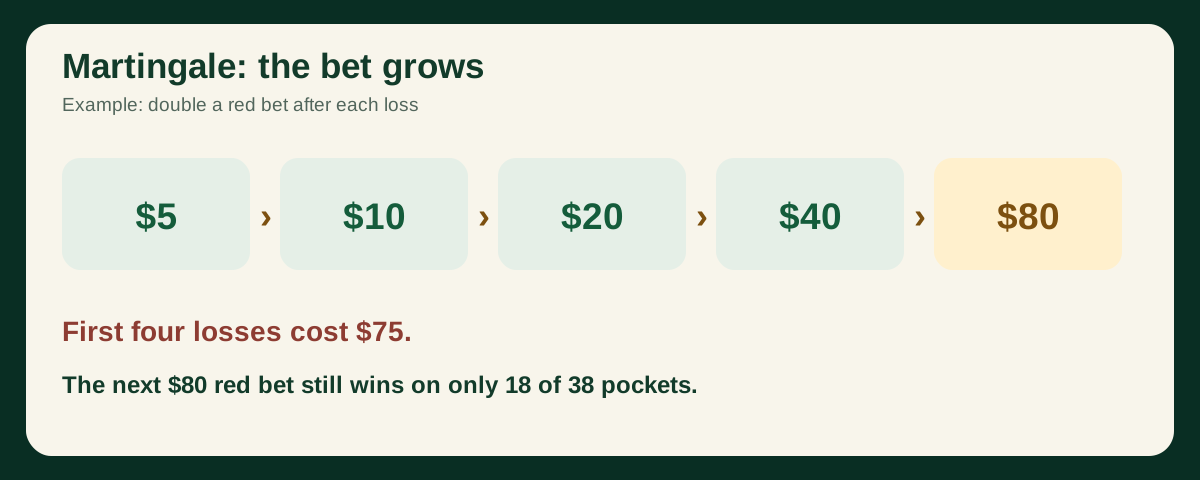
What can a betting system control?
It can control which bet you make and how much you put down. It cannot make red more likely after black, or predict the next pocket. On a standard American wheel, a red bet wins on 18 of 38 pockets. The 18 black pockets and two green pockets defeat it. Every new spin starts with the same wheel.
Most standard American roulette wagers have a 5.26% house edge. That percentage applies to the money wagered over time, not as a fixed loss on each spin. A system that increases your total amount staked can increase the dollars at risk even if it produces many small winning sessions.
| Approach | What you do | What does not change |
|---|---|---|
| Flat betting | Use the same amount each spin | Wheel probabilities and house edge |
| Martingale | Double after a loss, reset after a win | Wheel probabilities and house edge |
| D'Alembert | Increase one unit after a loss, decrease after a win | Wheel probabilities and house edge |
Follow a Martingale sequence in dollars
Start with $5 on red. Four losing spins call for bets of $5, $10, $20, and $40. You have lost $75. The next wager is $80, more than your first four wagers combined. If that $80 bet wins at 1 to 1, its $80 profit recovers the $75 and leaves $5. If it loses, the sequence is down $155 and asks for $160 next.
A bankroll or table limit can end the sequence before a recovery spin. More importantly, the $80 bet still has an 18 in 38 chance to win on a standard American wheel. Earlier losses do not change those 38 pockets.
La Partage and En Prison rules on some European tables change certain even-money outcomes. The Lucky Penny roulette practice wheel is American with both 0 and 00, so use its 38-pocket math here.
Use the Strategy Lab as a test
Pick a fixed number of practice spins and a fixed starting bankroll. Record total amount wagered, largest single bet, final balance, and whether a table limit would have stopped your plan. Compare a flat $5 wager with a progression using the same starting balance. Several short trials reveal how volatile a progression can feel, but a few trials cannot prove a system beats the wheel.
If your goal is to understand the game, learn how a bet covers pockets and what it pays before choosing a staking pattern. Bet sizing is a bankroll decision. It is not a way to change the wheel's expected return.
Try it at the table
Use practice credits to see how the rules work one decision at a time. There is no real-money wagering or cash prize.
Open roulette practice