
Roulette Payout Chart: American Wheel Odds and Returns
See what each American roulette bet pays, how often it can win, and what a winning chip returns. The five-number basket has a higher house edge than the standard bets.
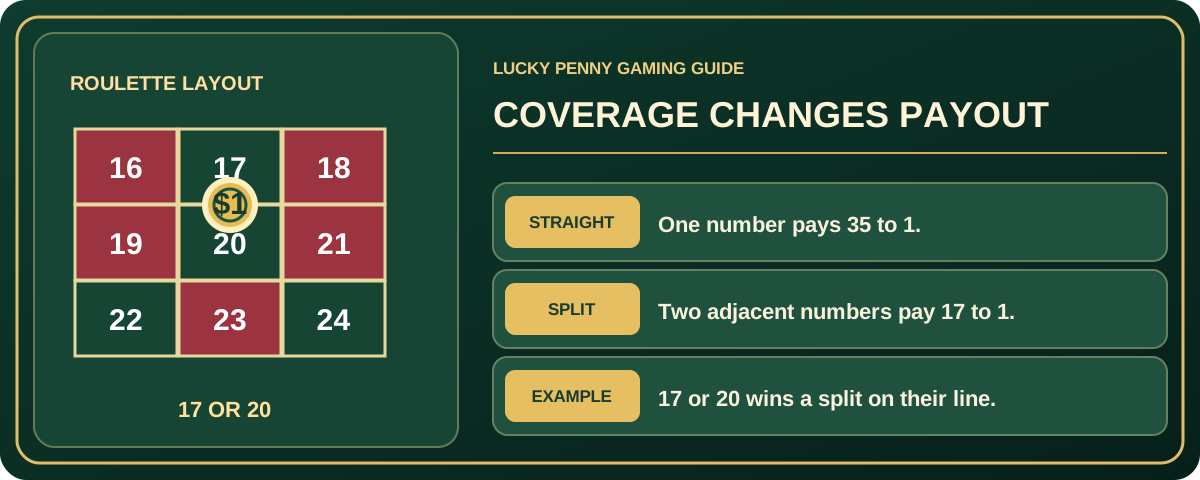
A payout such as 35 to 1 means $35 in profit for every $1 wagered, plus the return of your original winning chip. Most standard bets on an American roulette wheel have the same 5.26% house edge. The main differences are how frequently the wager wins and the size of the payout.
Payout is not the same as total return
Roulette odds describe your profit. If a $1 straight-up wager wins at 35 to 1, you receive $35 in profit and your original $1 wager back. Your total return is $36.
Keeping profit and total return separate makes it easier to verify how a winning wager was settled.
American roulette payout chart
Winning chances use all 38 pockets: numbers 1 through 36, plus 0 and 00. Example amounts show profit only; add the original winning chip for total return. The five-number basket is shown for comparison and is not offered on Lucky Penny.
| Bet | Covers | Pays | Chance | Example profit | House edge |
|---|---|---|---|---|---|
| Straight up | 1 number | 35 to 1 | 2.63% | $1 wins $35 | 5.26% |
| Split | 2 numbers | 17 to 1 | 5.26% | $1 wins $17 | 5.26% |
| Street | 3 numbers | 11 to 1 | 7.89% | $1 wins $11 | 5.26% |
| Corner | 4 numbers | 8 to 1 | 10.53% | $1 wins $8 | 5.26% |
| Double street (six line) | 6 numbers | 5 to 1 | 15.79% | $1 wins $5 | 5.26% |
| Five-number basket* | 0, 00, 1, 2, 3 | 6 to 1 | 13.16% | $1 wins $6 | 7.89% |
| Dozen or column | 12 numbers | 2 to 1 | 31.58% | $5 wins $10 | 5.26% |
| Even money | 18 numbers | 1 to 1 | 47.37% | $5 wins $5 | 5.26% |
* The five-number basket has a 7.89% house edge; the standard bets above and below it have a 5.26% edge. Lucky Penny does not offer the basket.
Four payouts in actual dollars
$1 straight up on 17
$35 profit plus your original $1 wager if 17 wins.
$1 split on 17 and 20
$17 profit plus your original $1 wager if either number wins.
$1 corner on 16, 17, 19, and 20
$8 profit plus your original $1 wager if any covered number wins.
$5 on Red
$5 profit plus your original $5 wager if a red number wins.
Standard bets share the same underlying cost
Consider a $1 bet on Red. Eighteen red pockets win $1. Eighteen black pockets lose $1, and both green pockets also lose. Across all 38 possible results, the two green pockets create an average casino advantage of 2 divided by 38, or about 5.26%.
The percentage is a long-run mathematical average, not a prediction for your next five spins. Short sessions can vary widely from this average.
The five-number basket costs more
Some American roulette layouts offer a single bet covering 0, 00, 1, 2, and 3. It usually pays 6 to 1 and carries a house edge of about 7.89%, which is worse than the standard 5.26% bets.
The additional house edge comes from the 6-to-1 payout, which is lower than the fair payout for five covered pockets. Lucky Penny currently supports zero-area straight and split bets rather than this five-number basket.
Inside or outside: which should you choose?
Less frequent, larger wins
Straight-up, split, street, and corner bets cover fewer numbers. They create more losing spins and larger individual payouts when they connect.
More frequent, smaller wins
Dozens, columns, red, black, odd, even, low, and high cover more numbers. They win more often, but the payout is smaller.
Most of these bets carry the same house edge, so the choice is mainly about volatility. Choose based on your preferred balance of hit frequency and payout size, not recent wheel results.
Three payout mistakes to leave at the door
- Counting the original chip as profit: A $1 straight-up winner returns $36, but only $35 is profit.
- Treating Red as a coin flip: Red covers 18 pockets, while 20 pockets make it lose because 0 and 00 are green.
- Assuming a bigger payout means better odds: The larger prize compensates for a smaller chance of winning.
Practice with the Lucky Penny Table Minimum
Lucky Penny uses a $5 total table minimum. Inside positions can start at $1, so five separate $1 number bets qualify. Each outside position, such as Red or a dozen, requires at least $5.
The table settles every position separately and keeps the complete result in Recent Spins, making it easy to compare the payout chart with what actually happened.
Practice Roulette Payouts
Place a few inside and outside bets with free practice credits, spin the wheel, and open the result details. Reviewing each settled wager alongside the chart helps reinforce how coverage and payouts work.