
Player vs. Banker: Which Baccarat Bet Is Better?
Banker and Player are both competitive wagers, but they are not mathematically identical. Banker wins slightly more often and remains the lowest-house-edge standard bet even after commission.
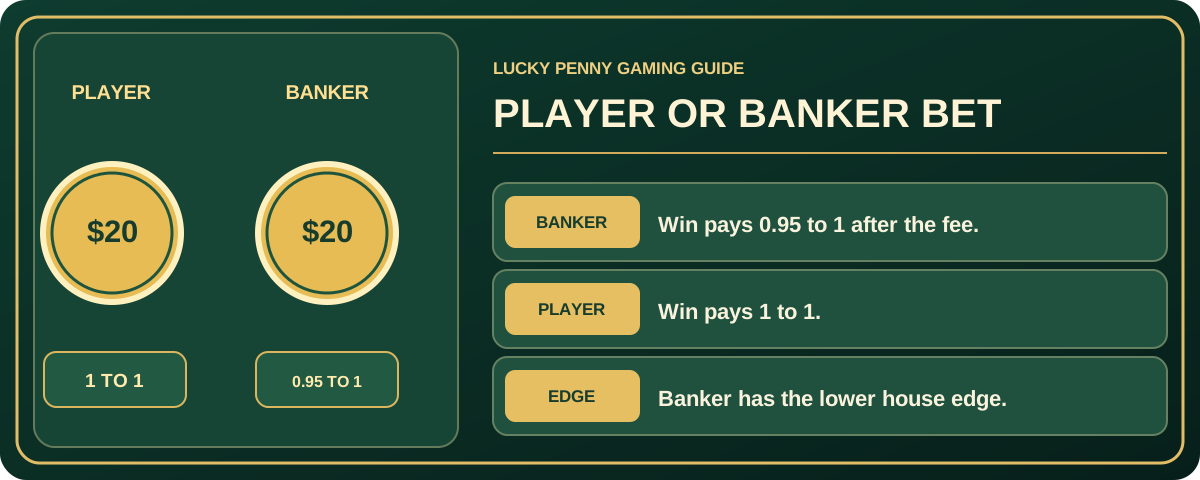
Banker is the strongest standard wager under the Lucky Penny rules. Its approximate house edge is 1.06%, compared with 1.24% for Player. Player remains a reasonable alternative for anyone who prefers an even-money payout without commission calculations. Tie carries a much larger 14.36% house edge.
Player and Banker are betting positions
You do not become the Player or act as the Banker. Those words identify the two hands dealt on the table. Before each round, you may wager on the Player hand, the Banker hand, or a Tie. The dealer then follows the automatic drawing rules and compares the final totals.
A Tie does not cause a standard Player or Banker wager to lose. Those wagers push, which means the original stake is returned. A separate Tie wager wins only when both hands finish with the same total.
Player, Banker, and Tie compared
These figures use an eight-deck game with a 5% commission on winning Banker wagers and an 8-to-1 Tie payout. Win probability includes all completed hands, including rounds that produce a Tie.
| Bet | Win probability | Push probability | Winning payout | House edge |
|---|---|---|---|---|
| Banker | 45.86% | 9.52% | 0.95 to 1 | 1.06% |
| Player | 44.62% | 9.52% | 1 to 1 | 1.24% |
| Tie | 9.52% | None | 8 to 1 | 14.36% |
The drawing rules favor Banker slightly
The Player hand acts first under Baccarat's drawing rules. If Player receives a third card, the Banker drawing decision can depend on the value of that card. This structural advantage causes Banker to win about 45.86% of all hands, while Player wins about 44.62%.
When Tie results are removed and only decisive hands are considered, Banker wins about 50.68% of those decisions. Casinos offset that advantage by taking a 5% commission from winning Banker wagers. Even after that adjustment, Banker retains the lowest house edge of the three standard bets.
What the payouts look like
$20 on Banker
The 5% commission reduces an even-money $20 profit by $1. If the result is Tie, the original $20 wager is returned.
$20 on Player
Player pays even money without commission. If the result is Tie, the original $20 wager is returned.
$20 on Tie
The larger payout reflects a much lower winning probability. Player or Banker winning causes the Tie wager to lose.
Expected loss is a long-run average
For every $1,000 wagered over a very large number of hands, the mathematical expected loss is approximately $10.58 on Banker, $12.35 on Player, and $143.60 on Tie. Those figures do not predict the result of a particular hand or session. Short-term results can vary substantially in either direction.
Banker and Player are close. Tie is not. Its 8-to-1 payout looks attractive, but the payout is not high enough to compensate for how rarely the wager wins.
Does a streak change the better bet?
No. A run of Player or Banker results does not alter the fixed drawing rules or make the opposite outcome due. The Bead Road and session scoreboard are useful records of completed hands, but they do not forecast the next result.
If the objective is simply to choose the lowest-house-edge standard wager, Banker remains the answer on every hand under these rules. Switching sides based on recent outcomes does not improve the underlying percentages.
Three points to check at a casino
- Banker payout: Confirm whether the table takes 5% commission or uses a commission-free variation with different rules.
- Tie payout: Some tables pay 8 to 1 and others pay 9 to 1, which changes the house edge.
- Minimum wager: The table minimum may apply separately to each betting position.
Compare Player and Banker in practice
Place practice wagers on the Baccarat table, deal several hands, and open Recent Hands to review the payout and commission on every result.
Practice This on the Baccarat TableRules, probabilities, and house-edge reference: Wizard of Odds Baccarat analysis. Casino procedures and alternative payout schedules can vary by table.