
Craps Maximum Odds: 3-4-5x Rules and Payouts
Craps odds are unusual because they pay at true mathematical odds. This guide explains the 3-4-5x structure, proper wager amounts, payouts, and total money at risk.
3-4-5x Odds Calculator
Choose the point and enter your Pass Line wager. The calculator shows the maximum odds, payout, and total money involved if the point repeats before 7.
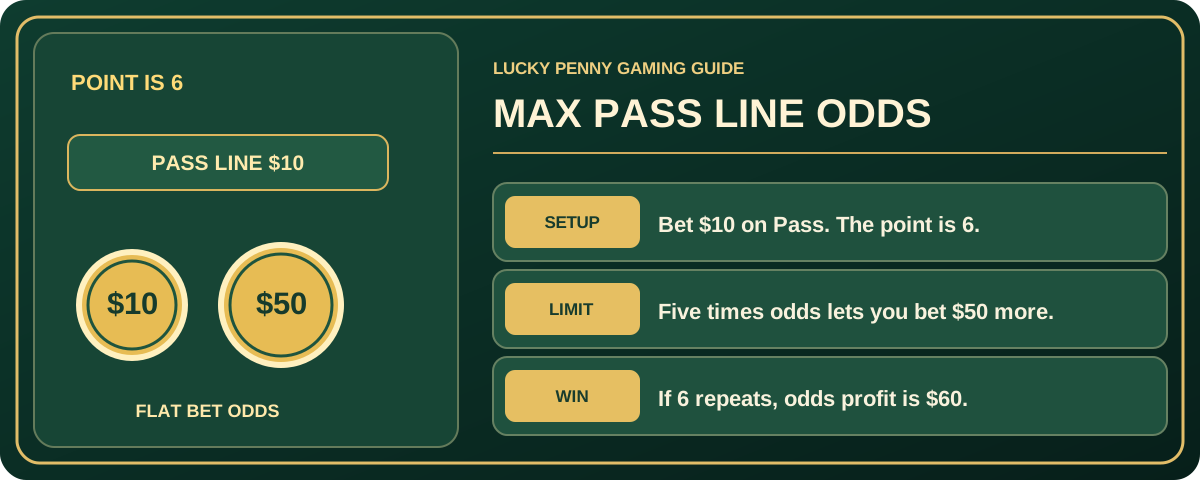
Your $10 Pass Line bet wins $10, and your $50 odds bet wins $60. You receive $130 back, including your original wagers.
The odds portion has a 0% house edge because it pays at true odds. The required wager changes with the point, but maximum 3-4-5x odds always win six times your original Pass Line bet.
What is an odds bet in craps?
Start with a Pass Line bet before the come-out roll. If a point is established, you may place an additional odds wager behind the Pass Line. The flat bet and the odds bet then want the same result: the point must repeat before a 7.
The Pass Line bet pays even money. The odds bet pays according to the actual probability of making the point. That is why points 4 and 10 pay more than 6 and 8. Four and 10 are simply harder to repeat before 7.
How 3-4-5x odds work
The maximum multiple depends on the point. Here is what happens behind a $10 Pass Line bet.
| Point | Maximum | Odds pay | Maximum odds bet | Odds profit |
|---|---|---|---|---|
| 4 or 10 | 3x | 2:1 | $30 | $60 |
| 5 or 9 | 4x | 3:2 | $40 | $60 |
| 6 or 8 | 5x | 6:5 | $50 | $60 |
This consistent $60 odds profit is the defining feature of the 3-4-5x structure. Add the $10 Pass Line win, and making any point produces $70 in total profit when maximum odds are behind it.
Zero house edge does not mean zero risk
An odds bet can still lose. It has no house edge because the payout fairly matches the probability, not because the wager is guaranteed to win. If 7 appears first, both the flat bet and the odds bet lose.
The original Pass Line wager still carries a house edge of about 1.41%. Adding odds lowers the casino advantage as a percentage of your total action, but it does not erase the expected loss attached to the flat wager.
Should you always take maximum odds?
Maximum odds are mathematically efficient, but they also increase the amount exposed on a single decision. With $10 on the Pass Line, you may have $40, $50, or $60 total at risk depending on the point.
If that amount does not fit the session bankroll, taking fewer odds is reasonable. A smaller wager paid fairly is still paid fairly. The appropriate amount is the one that fits your session bankroll and risk tolerance.
Keep smaller odds bets proper
Maximum 3-4-5x wagers automatically produce whole-dollar payouts. If you take less than maximum, use these increments to avoid rounding.
Individual casinos may apply different maximums and rounding procedures. Check the table sign or ask the dealer before wagering.
One more useful comparison
Place bets and Pass Line odds can both involve the box numbers, but their payouts and house edges are different. Review the proper-bets guide before assuming wagers on the same number have the same payout structure.
Read the Proper Craps Bets guide →Practice the entire Pass Line and odds cycle
The guided lesson walks through the come-out roll, establishes a point, adds odds, and forces a point winner so you can see the payout happen on the table.