
Blackjack insurance explained
When the dealer shows an ace, the table may offer insurance. The name makes it sound like protection for your cards, but it is a separate wager on the dealer having blackjack. Your own hand can win or lose independently.
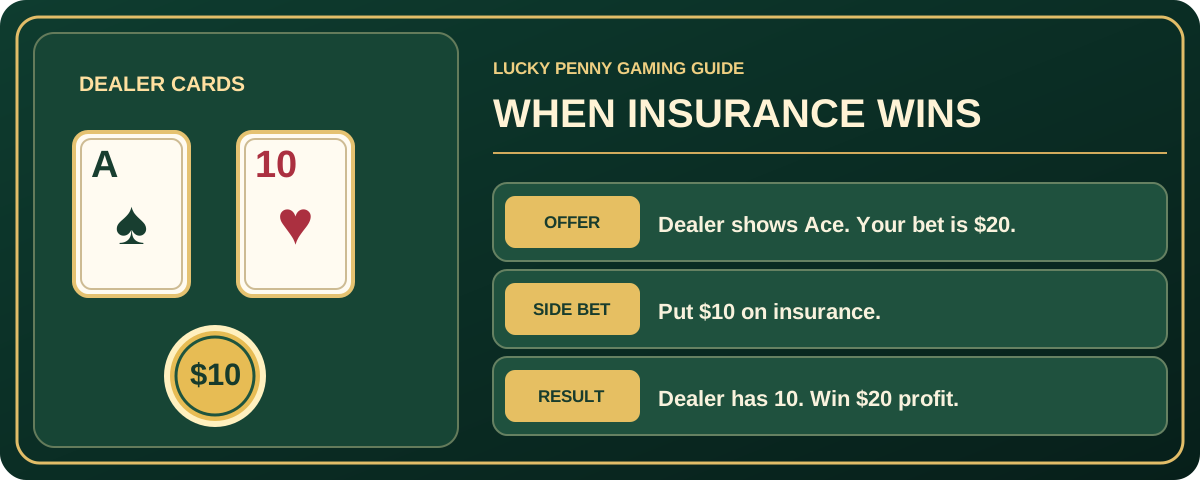
When can you take insurance?
The choice appears after the initial deal when the dealer has an ace face up. You may place an additional wager of up to half your original blackjack bet. On the Lucky Penny practice table, the offered insurance amount is exactly half your bet. The dealer checks for blackjack before you make the usual hit, stand, double, or split decision.
Insurance wins only if the dealer has a ten value card underneath the ace. A 10, jack, queen, or king completes that blackjack. If the dealer has any other hole card, insurance loses and your regular hand continues.
How does the 2 to 1 payout work?
Suppose your original wager is $20. Full insurance costs another $10. If the dealer has blackjack, your insurance earns $20 in profit and your $10 insurance stake comes back. If your ordinary hand loses its $20 wager, the insurance profit offsets that loss, leaving the round even.
| Dealer result | Insurance result | Regular hand |
|---|---|---|
| Dealer has blackjack | $20 profit plus $10 stake returned | Usually loses $20, unless your own natural blackjack pushes |
| Dealer does not have blackjack | Loses the $10 insurance wager | Continues and settles normally |
That offset is why the wager got its name. It is not a refund of your original bet. For example, your $10 insurance can lose even when your $20 blackjack hand later wins.
Is insurance a good bet?
At 2 to 1, insurance needs to win more than one time in three to have a positive expected return. In a fresh deck, 16 of the 52 cards are worth ten, which is less than one third. The exact chance changes with the cards already seen, but without useful information about the cards left in the shoe, insurance is generally a costly extra wager.
Your own 20 does not change what insurance pays. The question is whether the dealer has blackjack, not whether your hand feels too strong to risk. On a table with several decks, knowing the mix of remaining cards can change the calculation, but guessing based on a streak cannot.
What about even money?
Some casinos offer even money when you have a natural blackjack and the dealer shows an ace. With a standard 3 to 2 payout on your blackjack, taking full insurance produces the same net profit as even money: one original wager. If the dealer has blackjack, your main hand pushes and insurance wins. If the dealer does not, your blackjack wins at 3 to 2 and the insurance stake loses.
Lucky Penny offers the insurance choice rather than a separate even money button. If you decline insurance, a natural blackjack keeps its usual 3 to 2 payout when the dealer does not have blackjack. Read the posted blackjack and insurance payouts at any casino, since rules can differ.
Common questions
Does insurance protect a hand of 20?
It only pays if the dealer has blackjack. Your total of 20 is settled separately.
Can insurance lose while my hand wins?
Yes. If the dealer has no blackjack, the insurance wager loses. Your hand can still win later.
What does the practice table charge?
It offers insurance equal to half your original wager when the dealer shows an ace. You can take it or decline it before play continues.
Rules reference
The Nevada Gaming Control Board blackjack rules describe the half size insurance wager and its 2 to 1 payment. The examples above also match our practice table.